Forklift Transport: Why Lifting Capacity Is Not the Machine’s Weight
A forklift advertised as “2.5 tonne” usually refers to its rated load-handling capacity, not necessarily its own weight. The machine itself can be substantially heavier. For safe transport, the actual operating mass, tyre type, mast height, attachments and loading access matter.
Two different numbers appear in forklift descriptions
The rated capacity tells you what the forklift is designed to lift under defined conditions; operating weight is the mass of the forklift itself. Counterweights, battery packs, masts, fork attachments and additional equipment all contribute to operating mass. A forklift rated to lift a particular weight can exceed a light transport truck's actual payload allowance.
Instead of saying “it's a three-tonne forklift,” find the manufacturer's data plate and model information. Ask the equipment owner for operating mass in its current configuration, including attachments and any removable components. Do not estimate transport suitability by the label on the mast or by fork rating alone.
Height and footprint can matter as much as mass
A tall mast may make the total loaded height unsuitable for some routes or equipment. Check the lowered mast height, overall length including forks, width, tyre type and whether the mast can be placed in its transport position according to manufacturer instructions. A reach forklift and a conventional counterbalance forklift can have very different dimensions and load distribution.
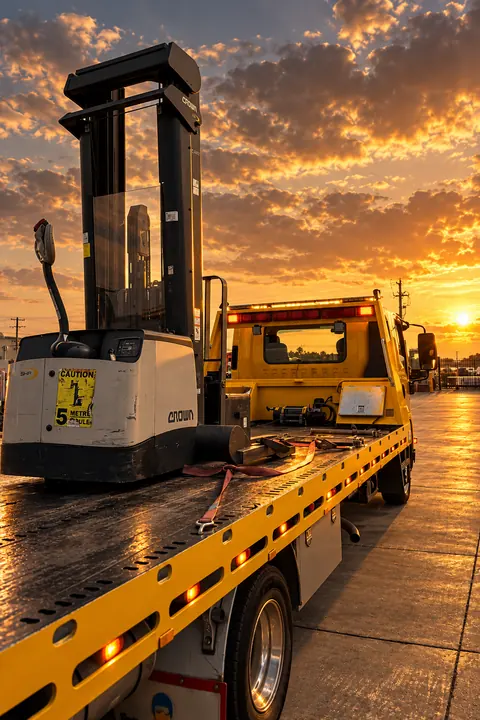
The truck will also need a suitable access route and a stable loading surface. Warehouse ramps, docks, uneven concrete and narrow gates can change the plan. Some forklifts require specialised low-loaders or cranes rather than standard tilt trays.
The restraint plan must match the actual machine
Heavy equipment requires appropriate placement and restraint. The National Heavy Vehicle Regulator's loading guidance emphasises correct load information and secure handling. The operator must determine correct equipment, rated points and loading procedures rather than copying a generic strap setup.
Do not climb or drive a forklift onto a truck unless the operator has a suitable, approved loading plan and a competent operator. Where the machine is non-running or has brake problems, a further assessment may be necessary.
Forklift details to send for a Brisbane quote
- Make, model and data plate photo where available.
- Actual operating weight, not simply rated lift capacity.
- Length, width and lowered mast height, including any attachments.
- Tyre type and whether the machine runs, steers and brakes.
- Loading and unloading access, floor surface and who will operate the forklift if required.
BTC's forklift transport Brisbane page covers suitable jobs; the broader machinery transport service has an actual-load assessment limit. Large machines should be referred to a suitably equipped specialist.
Forklift transport FAQs
Does “2.5t forklift” mean it weighs 2.5 tonnes?
No. That often describes rated lifting ability. Check the manufacturer's operating mass for the exact machine and configuration.
Can a forklift be moved with attachments fitted?
That depends on mass, dimensions, securement and manufacturer instructions. Identify every attachment for the quotation.
Is a forklift with a dead battery a normal pickup?
Not necessarily. Loading may differ for a machine that cannot drive, steer or release brakes. Provide the fault description before dispatch.
Need a suitable Brisbane tow or transport quote?
Tell BTC the vehicle or machinery model, exact pickup and destination, whether it rolls or operates normally and any access limitations. We assess suitable non-crash jobs and confirm the quote and current availability before dispatch. No underground car-park recovery.