Machinery transport
For suitable compact plant, equipment and worksite loads beyond dedicated forklift moves.
Machinery transport Brisbane →
Forklifts are compact but heavy, so the transport decision has to be based on the machine's real operating weight, mast height, dimensions, condition and access — not just the lifting-capacity number on the side.
This is one of the most important details in a forklift transport quote. A forklift described as “2.5 tonne” commonly means it is rated to lift around 2.5 tonnes. That does not tell us what the forklift itself weighs.
Before accepting the job, we need the forklift's actual operating or service weight from the data plate, manufacturer specifications or reliable model information.
The load the forklift is designed to lift under specified conditions. This is not the machine's road-transport weight.
The forklift's own operating/service weight is what matters for tray capacity, loading position and legal transport suitability.
Accurate information prevents the wrong truck being dispatched and makes the quote much more reliable.
Forklift design varies significantly. The model and specifications matter more than the label customers commonly use for the machine.
A forklift at or below 3.5 tonnes is not automatically suitable. The assigned truck must be legally capable of carrying the actual machine weight, and the forklift must physically fit and be loadable at both sites.
Forklift moves are commonly planned between warehouses, workshops, dealers, depots and industrial sites. Availability and suitability are confirmed for each job.
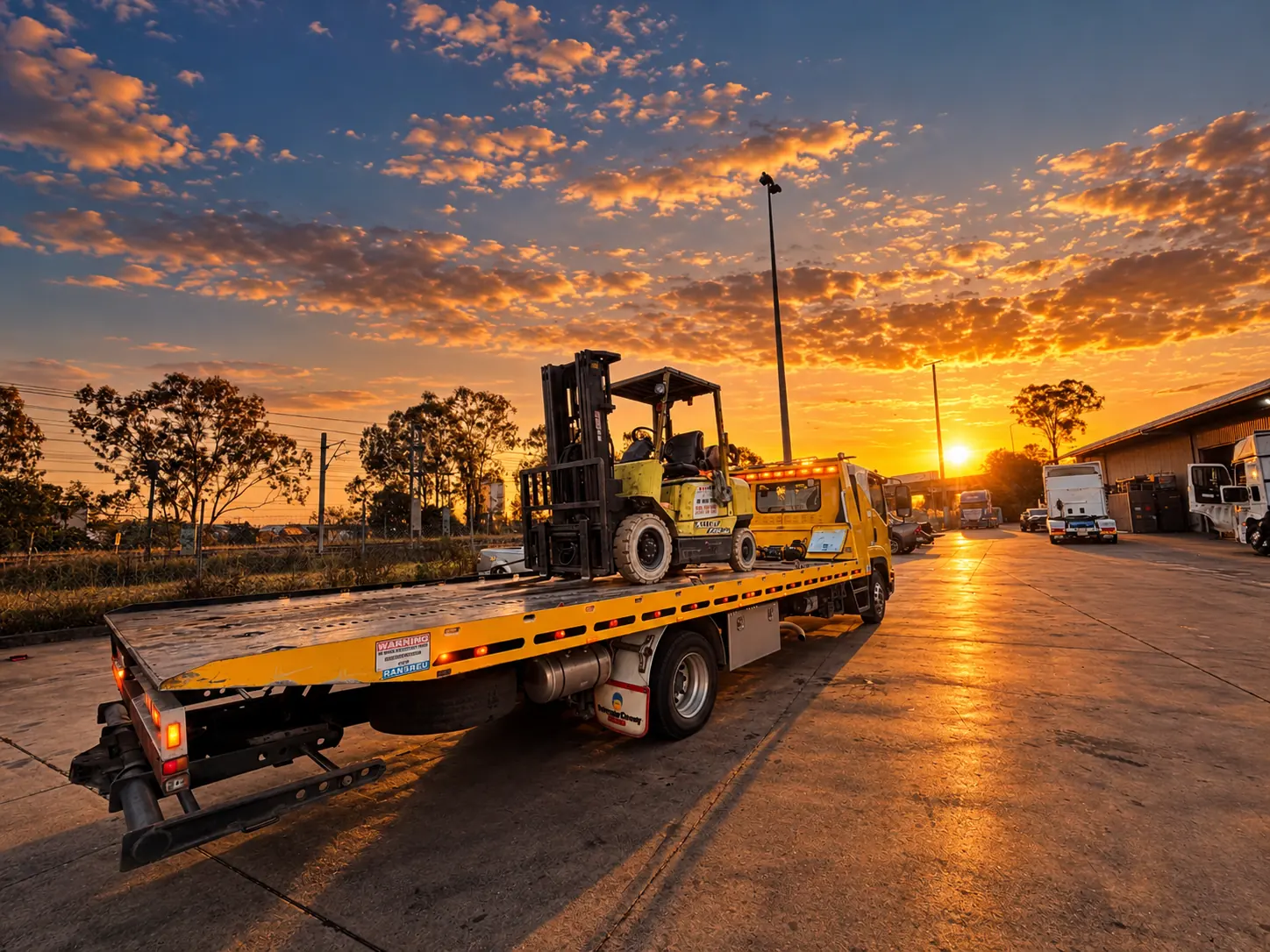
Our team has completed forklift transport between Sumner and Darra in Brisbane’s western industrial corridor. That type of job is exactly why the dedicated forklift page asks for actual machine weight, mast height, dimensions and site access before dispatch.
Request a forklift quoteForklift transport is quoted around the actual machine and site conditions rather than a generic vehicle-towing rate.
Suitable forklifts can be assessed if the actual machine weight, dimensions, mast height, condition, loading access and destination access are within the capacity of the assigned tilt tray.
Not necessarily. “2.5 tonne” often describes the forklift’s rated lifting capacity, not what the forklift itself weighs. For transport we need the real operating or service weight from the data plate, manufacturer specifications or reliable model information.
Send the make and model, actual operating weight, overall length and width, mast height, whether it runs and rolls, tyre condition, pickup and destination, site access and preferred timing.
Possibly. We need to know whether it rolls, steers, has locked wheels or brakes, the condition of the tyres and whether it can be loaded and restrained safely at the site.
Suitable forklifts can be assessed up to 3.5 tonnes actual load weight, subject to dimensions, weight distribution, site access and the legal carrying capacity of the assigned truck. Rated lift capacity is not used as the transport weight.
The mast contributes to the forklift's overall travel height and can affect loading, route clearance and how the machine sits on the tray. The lowered mast height should be provided where possible.
Send the make, model, actual machine weight, mast height, pickup and destination so we can check the job before dispatch.